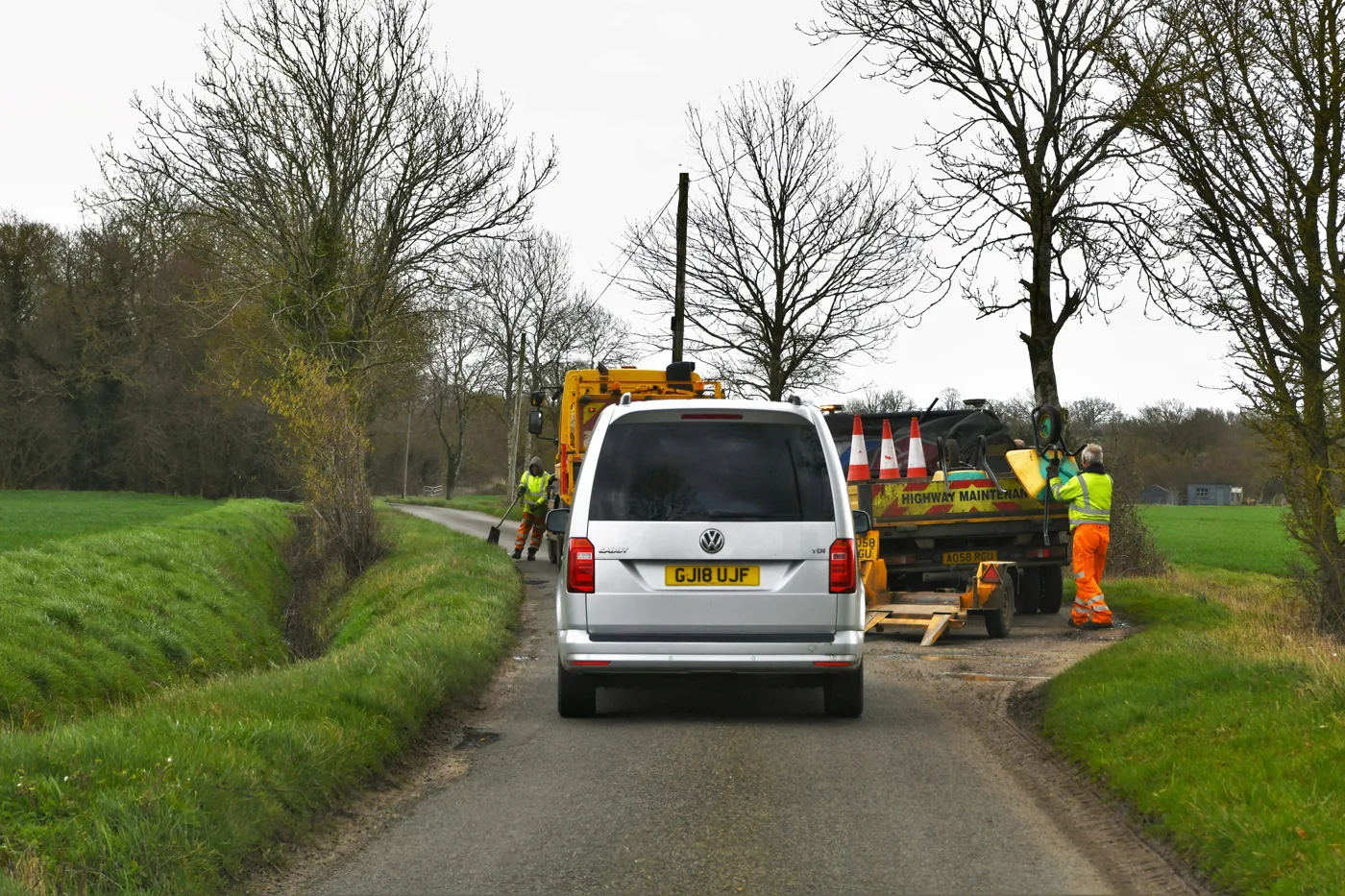

A record 6% of Norfolk's A roads are rated red, the worst in 18 years. The six-week repair standard, and why a pothole ringed in paint needs no report.
South Norfolk is getting a pothole machine, for one week, for nothing.
Norfolk County Council announced on 11 August that it will trial the JCB Pothole Pro during the first week of September. It will be used on planned repairs in South Norfolk. The machine and its operator are being provided at no cost to the council for the trial.
The council’s own description of what it is testing:
- the machine is designed to repair potholes and carriageway defects more quickly than traditional methods
- the trial will assess whether it delivers longer-lasting repairs
- it will also test whether it cuts the time crews spend on site
- if the trial goes well, a longer trial will be arranged
Tom Dickerson, the county council’s cabinet member for highways, infrastructure and transport, said the machine “has been praised by others for its ability to carry out repairs quickly and efficiently, and this trial will help us understand how it performs on Norfolk’s roads”.
What the announcement does not say
Four things a driver in this district would want to know, and which the council has not published:
- which roads in South Norfolk will be repaired
- how many days the machine will be here, beyond “the first week of September”
- what a longer-term arrangement would cost, once the free week ends
- how the results will be judged, or whether the assessment will be published
We have not invented answers to any of those. If the council publishes the locations, we will add them here.
The roads it will be working on are getting worse
The trial arrives after the sharpest deterioration in Norfolk’s recorded road condition in nearly two decades.
The Department for Transport asks every highway authority to survey its network and report the share in red condition. Red does not mean a road is full of potholes. It means the surface data says the road should have been investigated to see whether work was needed.
In the year to March 2025, 6% of Norfolk’s A road length was red. That is up from 4% the year before, and it is the highest figure in the 18 years the series has run. Norfolk had never previously gone above 4%.
Norfolk was not alone. Across England the A road figure rose from 4% to 5%, and 66 of 149 authorities got worse. Neighbouring Suffolk doubled from 3% to 6% in the same year. But Norfolk’s B and C roads also slipped, from 6% to 7%, which matches the England figure exactly.
The county’s official rating: amber on everything
The Department for Transport now rates every highway authority on three things: the condition of its roads, what it spends on them, and how closely it follows best practice.
In the ratings for 2025 to 2026, published on 11 January 2026, Norfolk was rated amber on all three, and amber overall. Nationally, 16 authorities were green, 125 amber and 13 red.
That puts Norfolk in the middle with almost everybody else. Among its neighbours, Essex was green and Suffolk was red, marked down for its spending.
What it means for you
- You do not need to report a pothole that has already been outlined in paint. The council says those have been inspected and are due to be fixed.
- Report the ones that have not. Norfolk’s pothole reporting form shows a map of what has already been logged, so you can check before you spend the time.
- The council’s own standard is six weeks. It says all potholes “will likely be repaired within six weeks of identification”, with anything posing a significant risk made safe sooner.
- Priority is not first come, first served. Repairs are ranked by the size of the defect, where it sits in the road and how busy the road is, under the council’s Transport Asset Management Plan.
The first week of September is also when the district’s roads are busiest with term-time traffic, and a fortnight before the A11 closes completely between Wymondham and Thickthorn for a weekend.
For the rest of the practical information on this site, see our pages on roadworks and travel, planning applications, house prices and train times to London.
Sources
- Norfolk County Council, Norfolk County Council set to trial the JCB Pothole Pro, published 11 August 2026, for the trial dates, the South Norfolk location, the no-cost arrangement and the quotation.
- Department for Transport, Road conditions in England to March 2025, published 21 January 2026, for the England figures and the definition of red, amber and green condition.
- DfT table RDC0120, percentage of local A road and B and C road length where maintenance should have been considered, by local authority, for every Norfolk figure and the comparison with Suffolk and England.
- DfT, Local road maintenance ratings 2025 to 2026, published 11 January 2026, for Norfolk’s amber ratings and the national totals.
- Norfolk County Council, Potholes for the inspection regime, the six-week repair expectation and how repairs are prioritised.
Have your say